Copyright strikes and demonetization claims have taught a generation of online creators a hard lesson: a beautiful track is worthless if it blocks a video from earning revenue or forces a last-minute muting. Against that backdrop, many producers have looked at AI-generated music with suspicion, worried the legal ground was as shaky as the early days of sampling. My recent deep dive into one platform was not about judging melodies first. It was about reading the fine print, testing whether the output could actually live inside a monetized project, and seeing if the licensing promise held up where it matters most—in a real publication workflow.
The AI Song Generator positions its royalty-free commercial terms front and center, so I built a realistic test scenario: a promotional podcast intro for a small e-commerce brand, a piece of audio that would be distributed across multiple platforms with no tolerance for rights ambiguity.
Why I Focused on License Language Before Any Audio File
Music licensing conversations often happen after the creative work is finished, which is backwards. My first action was not to generate a note. It was to examine the ownership and usage terms as they are presented to any user who lands on the site.
The Exact Promise a Creator Needs to Read
The platform states that the music you generate is royalty-free and includes commercial use. There is no mention of attribution requirements, no tiered licenses based on follower count or revenue thresholds, and no distinction between personal and business projects. In an industry where “royalty-free” sometimes hides a labyrinth of conditions, this flat clarity reduced my immediate skepticism.
What That Means for a Working Content Producer
With the terms confirmed, I could approach the creative process without a mental checklist of disclaimers. The knowledge that the final file could be placed into a podcast episode, a YouTube pre-roll, or an Instagram ad without triggering a separate licensing workflow changed the psychological starting point. Instead of treating the output as a placeholder that needed legal clearance later, I treated it as a potential final asset from the first generation.
Testing the Output Inside a Publication-Ready Workflow
The brief was simple: a 45-second intro with a confident, modern energy, something that could sit behind a brand message without overpowering the voiceover. I entered a description, waited, and downloaded the result.
From Prompt to a File That Survived a Multi-Platform Upload
I described a “driving electronic pulse with clean bass, positive mood, no aggressive synths.” The first generation landed close to the mark—polished enough to layer under a spoken intro. I inserted the downloaded MP3 into my DAW, added a gentle fade at the tail, and placed it in a draft timeline for the brand. The stereo width and frequency balance required no corrective EQ in my test, which is not a guarantee but a practical observation that saved editing time.
Rights Verification as Part of the Delivery Check
Before handing the finished podcast episode to the brand owner, I documented where the track came from and saved a screenshot of the platform’s licensing statement. This is standard due diligence, not paranoia. The difference from a typical stock music license was the absence of caveats: no need to specify distribution channels, no single-use restriction. That ease of documentation alone speeds up client approvals, because the conversation about music rights closes before it opens.
Walking Through the Creation Process When Rights Are Not an Afterthought
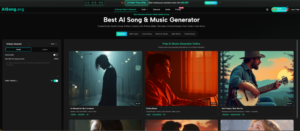
Because licensing clarity framed the whole session, the actual creation steps felt lightweight and focused. The platform does not gate its core functionality behind registration or a tour, which helped.
Step 1: Set the Creative Direction in Plain Language
I was greeted by a clean input area rather than a panel of intimidating controls. This simplicity reinforces the idea that the tool is built for decision-making speed, not technical showmanship.
Writing Prompts with Output Consistency in Mind
Through several generations, I noticed that the AI responded well to prompts that combined mood, tempo language like “mid-tempo,” and a list of desired or excluded instruments. It did not require musical jargon, but it rewarded precision. The process felt closer to writing a creative brief for a human composer than programming a synthesizer.
Using the Built-In Lyric Options When Words Are Needed
Although my test focused on instrumental music, I also explored the lyric writing capability for a separate curiosity. The platform offers a thematic lyric generator that builds words based on a topic and emotion. This can act as a creative springboard when you need a vocal demo without writing from scratch. The generated lyrics were structurally sound, if lyrically safe, and the AI placed them over a compatible instrumental when used together. This dual function of generating both words and music in one session is rare in tools that focus solely on audio.
Step 2: Generate and Preview Without Leaving the Page
Submitting the prompt triggered a server-side build. There were no export dialogs or format choices to slow the moment down.
The Queue Experience and Preview Behavior
A visible indicator showed the generation’s progress. During my session, the wait felt negligible, and once ready, the track played directly in the browser. This in-place audition prevents the desktop clutter of downloading multiple rejected candidates. I listened, decided whether to keep or refine, and moved on.
Step 3: Download the Final File with Terms Already Settled
The download provided a high-quality MP3, with the option for WAV on paid plans. No post-download popup asked me to select a license type or attribute the creator. The terms were the same every time, which meant my compliance step was already finished.
Why Uniform Terms Outperform Tiered Systems for Small Teams
For solo creators and lean production units, tiered licensing creates administrative drag. Choosing between a web license, a broadcast license, or an extended license is a time tax that rarely adds creative value. A single, flat royalty-free commercial license eliminates that drag entirely. When I placed the generated intro into the brand’s episode, I did not have to log a usage or set a calendar reminder to renew anything.
The Real-World Limitations Beneath the Licensing Promise
A strong legal framework does not erase the creative boundaries of generative AI, and I want to be direct about what the AI Song Maker cannot yet do, based on my testing.
Prompt interpretation still has a ceiling. When I asked for a “melodic bridge that feels like a memory half-remembered,” the result was pleasant but not evocative in a specific emotional way. The AI delivers functional mood music with high reliability, but the edge cases of deeply personal or abstract artistic intent remain outside its grasp. Users who need a track that carries a unique, intentional imperfection should still look to human collaboration or at least plan for more iteration.
The instrumental separation tool, while useful for quick karaoke-style extractions, leaves faint artifacts in the upper midrange. This is consistent with the current state of source separation technology, but anyone hoping for studio-grade isolation should calibrate expectations accordingly.
Complex dynamic requests—such as a tempo change halfway through or a key modulation—sometimes resolve into a simpler version of the idea. The model appears to prioritize coherence over risk, which in many commercial contexts is actually a strength, but musical explorers may bump against that smoothing tendency.
Finally, the free tier naturally has limits on the number of generations, which means power users will upgrade to a paid plan for sustained work. This is not a hidden flaw; it is the economic reality of any computer-heavy AI service. The licensing terms, however, do not degrade on the free plan—a notable detail that lets someone test the output in a real project before committing financially.
Music Licensing Confusion Versus the AIsong Approach
To show what changes when licensing leads the design instead of following it, here is a comparison between the typical rights-ambiguous music hunt and the defined-terms workflow this platform enables.
| Aspect | Typical Ambiguous Music Source | AIsong Platform with Clear Terms |
| License understanding before use | Often requires reading dense legal pages or contacting support | Stated plainly on the site, identical for every generation |
| Attribution requirement | Varies by track; a missed credit can trigger a claim | No attribution required, based on the stated policy |
| Commercial use clarity | May restrict by platform, impressions, or revenue model | Uniform commercial use included, no channel restrictions |
| Risk of future license changes | Stock libraries can alter terms or remove tracks retroactively | Generated tracks are tied to the user, not a shifting catalog |
| Documentation needed for clients | License certificates, usage logs, and sometimes sync rights proof | A simple acknowledgment of the platform’s terms suffices |
| Creative confidence during editing | Undermined by the question “will this clear?” | Replaced by the knowledge that clearance is pre-solved |
This table does not suggest that AIsong’s audio quality alone surpasses every professionally composed alternative. It does argue that for the growing segment of creators who have been burned by content ID claims or complex licensing matrices, the combination of acceptable audio quality and unmistakable legal safety is the actual product.
The shift that matters in AI music is not only about how many seconds it takes to generate a song. It is about the moment a creator realizes they can publish without fear, build a brand sound without a lawyer, and focus on the edit instead of the metadata. In that specific sense, the most valuable feature on the platform might not be the generate button. It might be the sentence that says you already own what you just made.