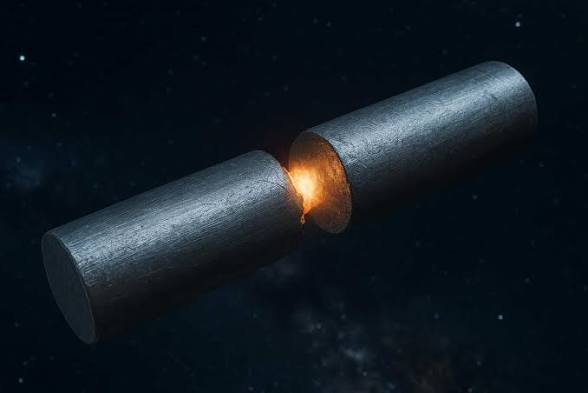
Here on Earth, it feels natural to assume that metal parts will stay separate unless we weld or glue them together. Place two clean aluminum sheets on a table and they behave as two independent objects. You can lift one without disturbing the other.
That everyday assumption collapses the moment you leave Earth’s atmosphere.
In the vacuum of space, those same two pieces of aluminum can permanently join the instant they touch. At the atomic level, their surface atoms begin sharing electrons, forming direct metallic bonds. Instead of two components, you suddenly have one solid mass. Separating them would require tearing the metal itself apart.
This effect is known as cold welding and it represents one of the most serious hidden dangers in spacecraft design. A jammed hinge in orbit is not a small inconvenience it can end an entire mission. If a solar panel cannot deploy or an antenna cannot rotate, the spacecraft becomes useless. Preventing this atomic-level bonding is a constant challenge for aerospace engineers working in the vacuum of space.
The Oxide Shield
To understand why cold welding is such a threat in space, it helps to see why it rarely occurs on Earth.
Earth’s atmosphere is full of oxygen and oxygen is highly reactive with metals. The moment a metal surface is exposed to air, it develops an extremely thin oxide layer. This layer may be invisible, but it plays a critical role. It acts as a barrier that blocks direct metal-to-metal contact, keeping the pure atoms beneath from interacting freely.
In space, that protection disappears. There is no oxygen to rebuild the oxide layer once it is scraped away. If two metal surfaces rub together and remove that coating, the exposed metal atoms remain bare. When these “clean” surfaces touch, the atoms don’t recognize any boundary. They bond instantly, merging into a single structure through cold welding.
The Failure of Liquids
At first glance, lubrication seems like an obvious solution. On Earth, oil or grease prevents metal surfaces from touching by creating a slippery film between them.
Unfortunately, space makes liquid lubricants almost useless. In a vacuum, most liquids rapidly evaporate in a process known as outgassing. Oils that work perfectly on Earth will simply boil away once exposed to low pressure.
This creates two serious problems:
- Loss of lubrication: As the oil evaporates, the joint is left dry. Bare metal surfaces are once again exposed to the risk of cold welding.
- Contamination: The vaporized lubricant doesn’t disappear. It floats through the spacecraft and eventually settles on cold surfaces, such as cameras, star trackers or optical sensors. This contamination can degrade or completely disable critical instruments.
Because of these risks, traditional liquid lubricants are avoided in most space mechanisms.
The Solid Solution: Molybdenum Disulfide
Instead of liquids, space engineers turn to solid materials for lubrication. One of the most widely used is molybdenum disulfide (MoS₂), commonly called “moly.”
Moly is a crystalline mineral with a layered structure, similar to graphite. These layers slide easily over one another, giving the material excellent lubricating properties. When applied as a bonded coating, moly forms a durable, dry film on metal surfaces.
This solid lubricant does not evaporate in a vacuum and remains stable across extreme temperature ranges. More importantly, it serves as a sacrificial barrier. As two coated parts move against each other, the moly layers shear and slide, absorbing friction. The underlying metal surfaces never come into direct contact, which prevents atomic bonding from ever occurring.
As long as the coating remains intact, cold welding cannot happen.
The “Galling” Threat During Launch
Cold welding risks are not limited to space itself. They also appear during assembly and launch on Earth.
Spacecraft are assembled using thousands of fasteners, often stainless steel bolts threaded into aluminum or titanium structures. Stainless steel is particularly prone to galling, a friction-driven form of cold welding. When a bolt is tightened too quickly, heat builds up in the threads, causing them to seize.
If galling occurs during rocket or satellite assembly, the bolt cannot be removed. It becomes effectively welded in place, often requiring drilling and risking damage to expensive components.
To prevent this, engineers apply coatings such as PTFE or moly-based films to fastener threads. These coatings reduce friction, ensure smooth torque application and prevent the heat buildup that leads to seizure.
Read More: What Roof Flashing Does and Why It Matters
Conclusion
Modern space missions rely on thousands of precisely timed movements, from unfolding solar arrays to adjusting scientific instruments millions of miles from Earth. Once launched, there is no chance for repair.
The silent guardian of these systems is not a motor or a computer, but the microscopic layers of aerospace coatings that separate metal surfaces. These specialized materials prevent cold welding, reduce friction and ensure reliability in an environment where failure is permanent.
Without them, spacecraft would lock themselves into rigid statues the moment they left Earth. Thanks to these invisible barriers, our machines can move, adapt and explore turning human curiosity into reality far beyond our atmosphere.