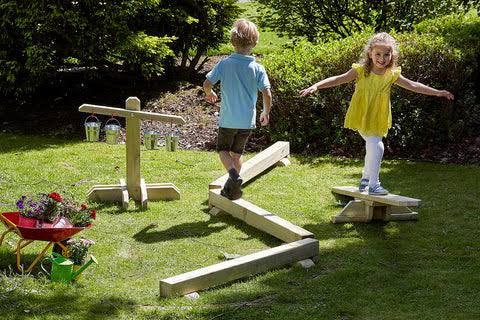
Incorporating outdoor balance equipment into playgrounds and recreational spaces provides targeted developmental benefits that support motor skill acquisition, proprioceptive development, and confidence building in physical abilities. Research from the Australian Council for Educational Research demonstrates children with regular access to varied balance challenges show 31% faster development of gross motor skills compared to peers using only traditional playground equipment. The neurological benefits extend beyond simple coordination to include improved focus, spatial reasoning, and risk assessment capabilities. Balance equipment categories range from simple beam walks to complex wobble platforms and rope bridges, each offering distinct challenges that engage different aspects of the vestibular and proprioceptive systems. Understanding how these equipment types support development helps communities and schools make informed decisions about playground investments.
Vestibular System Development
Balance equipment directly stimulates the vestibular system, which controls our sense of equilibrium and spatial orientation. This system develops through challenge and practice, with evidence showing that varied balance activities create stronger neural pathways than repetitive single-task exercises.
When kids walk across a balance beam, their inner ear detects changes in head position and sends signals to muscles throughout the body to make continuous micro-adjustments. This constant feedback loop strengthens the vestibular system over time, improving overall coordination and balance in all activities.
Physical therapy research indicates children who engage with balance equipment regularly demonstrate better postural control, improved reaction times, and reduced fall risk in daily activities. These benefits extend well beyond playground use into classroom settings where good posture supports focus and learning.
The variety of balance challenges matters significantly. Different equipment types stimulate the vestibular system in unique ways. Wobble platforms create multi-directional challenges, rope bridges introduce dynamic instability, and stepping stones require distance judgment and planning.
Proprioceptive Awareness and Body Control
Proprioception refers to our awareness of where our body parts are in space without looking at them. This sense develops through movement experiences that require precise body control, and balance equipment provides ideal conditions for this development.
When using balance equipment, children must consciously control their movements in ways that automatic activities like running don’t require. They need to adjust weight distribution, modify stride length, and coordinate arm movements to maintain stability. This heightened awareness builds stronger proprioceptive skills.
Occupational therapy studies show improved proprioception correlates with better handwriting, enhanced athletic performance, and reduced clumsiness in daily activities. Kids with strong proprioceptive awareness navigate spaces more confidently and experience fewer accidents.
I’ve noticed that children who struggle with spatial awareness often avoid balance equipment initially but show the most dramatic improvements with regular practice. The equipment provides immediate feedback about body position that helps them develop awareness they’re missing.
Core Strength and Postural Stability
Balance activities engage core muscles continuously to maintain upright posture on unstable surfaces. This represents functional strength training that occurs naturally through play rather than through structured exercise.
Core stability research published in Pediatric Exercise Science found children who used balance equipment three times weekly showed measurable improvements in core strength after just eight weeks. These improvements transferred to better performance in unrelated physical activities like ball throwing and jumping.
The core engagement required for balance differs from abdominal exercises typically prescribed for children. Balance challenges require coordinated activation of deep stabilizing muscles along with superficial muscle groups, creating functional strength that supports everyday movements.
Strong core stability reduces injury risk in sports and active play by providing better control during dynamic movements. Children with good core stability recover more effectively from slips and unexpected movements because their bodies automatically activate stabilizing muscles.
Graduated Challenge Levels
Well-designed balance equipment offers multiple difficulty levels, allowing children of different ages and abilities to find appropriate challenges. This progressive structure supports skill development as children master simpler tasks and advance to more complex ones.
Simple balance beams at ground level provide entry points for younger children or those with limited balance experience. As skills develop, they can progress to elevated beams, narrower walking surfaces, and equipment with dynamic elements like wobble platforms.
This graduated approach prevents frustration while maintaining challenge. Kids can see their progress clearly as they master equipment they previously found difficult. This visible improvement builds confidence and motivation to continue practicing.
Playground designers often arrange balance equipment in sequences that create natural progression paths. A layout might start with wide stepping stones, progress to a curved balance beam, then advance to a rope bridge, allowing children to build skills systematically.
Read More: Simple ways to maintain with swimming pool water treatment year round
Social and Cognitive Development
Balance equipment naturally creates situations requiring problem-solving and spatial planning. Children need to figure out foot placement, plan their path across complex equipment, and adjust strategies when initial approaches don’t work.
These cognitive demands make balance activities more than just physical exercise. Research in developmental psychology shows motor planning activities like those required for balance equipment support executive function development, including planning, working memory, and flexible thinking.
Social interaction occurs organically around balance equipment. Children encourage peers, offer tips about technique, and take turns on popular features. They also learn from observation, watching how others successfully navigate challenges and adapting those strategies.