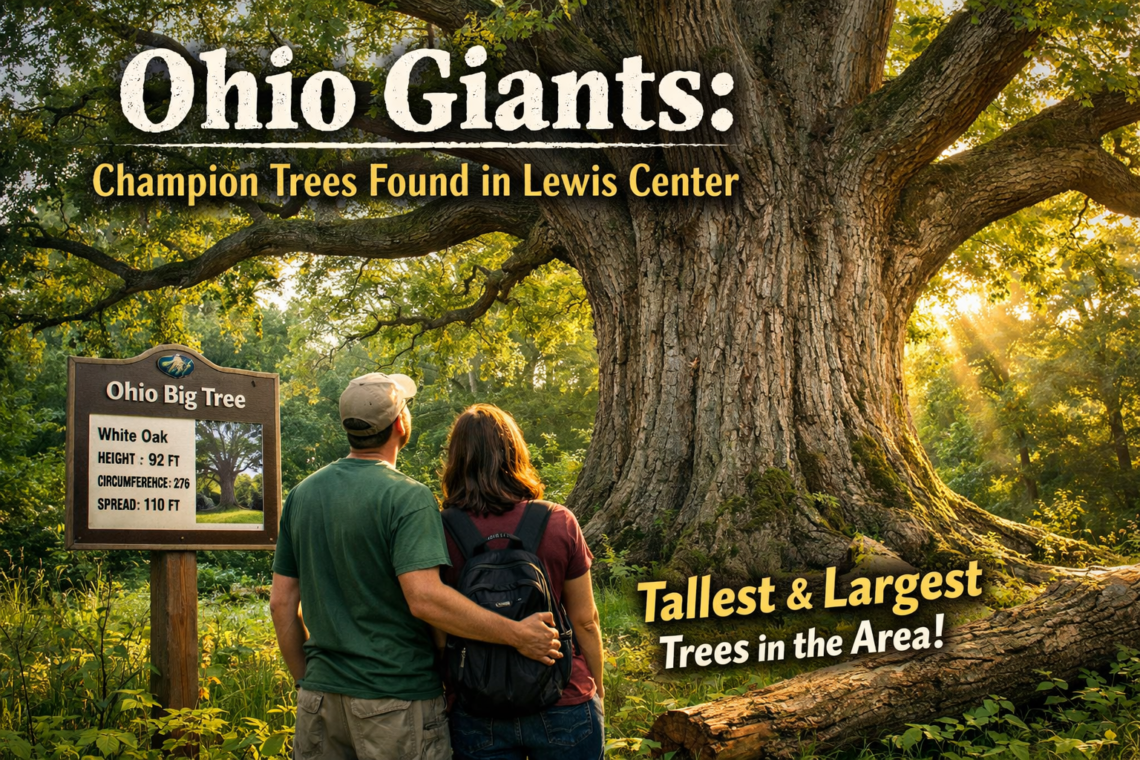
Some cities keep their histories hidden in museums or between the pages. In Delaware County and around Lewis Center in Ohio, the history is rooted deep in the ground and alive. You’re not imagining it if you have ever been driving through an area where you were drawn by a seemingly enormous tree. Unknowingly, you may have stumbled across one of these magnificent Ohio Champion Trees. This community treasures them.
They are often not marked by signs or fences, but they exist. These trees have a grander age and may be older than the surrounding structures. This is a tale told in the bark and leaves of a landscape that extends from suburb backyards, school grounds and forgotten areas that miraculously have escaped development. It’s not just a list of large trees, but an investigation of the natural heritage that continues to flourish despite all odds.
In the shadow of the giants, I have often felt an overwhelming sense of connectedness to the past. The experience of touching bark that’s survived centuries of droughts and storms is awe-inspiring. They are not just trees; they’re silent witnesses of the transition from farmland to bustling communities.
These trees anchor a community and provide a sense of permanence as the world changes rapidly. The purpose of this journey is to understand what makes Lewis Center’s Champion Trees so special. It is also about where they can be found and why we all have a stake in their survival.
What exactly makes a tree a “champion”?
It’s essential to know what “Champion Tree“, the name of the large tree in Lewis Center, means before we explore the park. This is not just an informal nickname for a large tree. The largest trees of a particular species in a specific geographic region, such as Ohio, are recognized by the Ohio Department of Natural Resources (ODNR) through its Ohio Champion Tree Program.
This process, which is managed by the Ohio Department of Natural Resources’ Ohio Champion Tree Program, is a mix of dedication and science. The program’s purpose is to celebrate and protect these living landmarks, as well as document them.
The status of a tree is determined using a three-point system.
- Circumference of the trunk: Measuring in inches from a height standard of 4.5 feet. The total score is increased by one point for each inch.
- Height total: Measuring in feet, from the bottom to the highest branch. Every foot in height adds one additional point.
- Median Crown Spread: Measure the horizontal spread of a tree’s branches at both its broadest and narrowest points. This is the average between these two measurements. A quarter point is given for every foot.
The three numbers added together create the total score. The state champion is the tree that has the highest scores for the species. Anyone who has hunted for giant trees will know that the numbers tell only part of the tale. Every score is an account of survival and resilience. It also reveals a dignity which numbers cannot convey.
Delaware County’s perfect environment: why it grows giants
Arborists and conservationists often use the phrase “Ohio Champion Trees, Delaware County”. This region has the perfect conditions for massive tree growth. Glaciers shaped the landscape thousands of years before, leaving behind rich, deep soils that are perfect for growing strong roots.
Long before the arrival of the first settlers, the gently rolling landscape and the abundance of waterways like the Olentangy River fed ancient, vast forests. The combination of fertile soil and abundant water made it possible for the trees to grow for many centuries.
Lewis Center in the south of the county is an excellent example of how this advantage can be used. This area is a rare intersection between old farmland and suburban development. The result is a mix of old and new trees that were left untouched or intentionally preserved as the development took place around them.
Despite the fact that many forest areas were cut down for agricultural purposes and then for housing development, some of these magnificent trees were left to grow unabated. A colossal oak stood proudly on someone’s lawn in a more recent development. It was a visible remnant from the old landscape. They had built around the tree, preserving a piece of living history which now defines an entire neighborhood.
Find Champion Trees in Lewis Center
Many people ask for maps or lists of specific champion trees, imagining that they are tourist attractions and have convenient parking. Reality is more interesting and subtle. Some champions can be found in public places, but many others are in plain view and on private land. It’s a good lesson to observe. You’ll find them in public parks, old school buildings, historical cemeteries and yards of homeowners who care about preservation.
They are rarely noticed. It is rewarding to find these trees if you pay attention. Look for trees that seem out of place, such as a trunk too large for the curb around which it curves or a canopy so tall overhanging the houses. A dazzling sycamore with its white bark shining in the sunlight was hidden behind a commercial building. This tree was there before concrete, asphalt and other modern constructions. It stood silently watching as the world changed. In a town like Lewis Center, big tree hunting is about finding the older trees that are too beautiful to be cut down.
Local Champions: A Closer Look
The Lewis Center region consistently showcases certain trees that thrive in Ohio’s climate. When given the time and space to grow, these trees can reach impressive heights. You can find the White Oak and Bur Oak, as well as Silver Maple, American Sycamore and Tulip Trees among the species that are most commonly found in Delaware County. The species have adapted perfectly to the soils and climate of Delaware County, which allows them to reach enormous sizes.
Some of the trees in this park are over 100 years old. Oaks and Sycamores could be as much as 200 or even more. The trees have seen the modern history unfold in Lewis Center. Silver maples are often found in low-lying areas where rainwater collects. This is where their roots thrive. The edge of a once dense forest might be dominated by a tulip, renowned for its tall height and straight trunk. They weren’t planted to be champions, but they have earned this status by simply surviving all that has been thrown at them, from lightning and ice storms to roads and neighborhood construction.
Public Lands and School Properties: The unsung heroes
The “USD” designation (Unified school district) is often overlooked when discussing local champion trees. The school property, as well as other public land like municipal and park grounds, is one of the best places to plant old trees. The land owned by school districts is seldom sold, and the development of these properties occurs slowly and carefully. The trees are usually left alone unless there is a safety issue for students or the building. The trees are able to grow and mature in a stable environment for many decades.
Imagine the large oak near the playground of the elementary school. The shade of its leaves and branches has provided shelter to generations of children. The trees are part of a community’s collective memory. A massive maple tree at my school’s campus, with its brilliantly red leaves in the fall, is a memory I will never forget. This tree remained a constant presence in my childhood, serving as a landmark and meeting place. You can see similar giants in Lewis Center along athletic fields and behind old school buildings. Their sprawling canopies provide shade, as well as a natural touch to campus.
The Human Element – Measuring the Champion
Sometimes, you might imagine a group of scientists using high-tech equipment and lasers to measure these trees. Most often, however, it is a motivated individual with a tape measure and notebook who begins the process. It’s a surprisingly personal process. The measurements are made with care, and accuracy is often checked twice. Anyone can follow the ODNR’s guidelines for measuring a tree correctly.
The program is unique because it’s driven entirely by the people. Any tree can be nominated by anyone who believes it is worthy of being a champion. You can send photos and measurements of a large tree you found in Lewis Center to the program. The owner must be contacted if the tree is located on their property. Sometimes, your nomination is close to breaking the record for the entire state, and you’ll be listed on a county-wide list of essential trees. Every so often, a citizen’s nomination dethrones an old champion and adds a new chapter in Ohio’s history.
Private Property Guardians
Unexpectedly, and this is important to note about Ohio’s Champion Tree Program, a high percentage of the trees are on private property. The homeowners are given a great deal of responsibility. They become unofficial guardians for a natural treasure that is recognized by the state. Some landowners did not even realize their tree was an award-winning tree until “big tree hunters” asked permission to measure the tree. Some people have known for a long time that their tree is special, and they have protected it.
They play an essential role in the preservation of these trees. These private citizens often spend a lot of money and go to extreme lengths to protect their prized trees. It may involve hiring arborists to provide proper care and pruning, installing fences to protect the roots, or redesigning the landscaping to fit the tree. Nobody forces anyone to follow this advice. The trees are cherished, and they do this out of respect for them. This quiet commitment is repeated across Lewis Center and throughout the state. It ensures that many of these trees will be around for generations to come.
The Future of Lewis Center Champion Trees
Ohio’s Champion Trees are a story of change. The growth in Delaware County isn’t slowing, but the development pressure is real and persistent. It’s not true that big means invincible. Large, older trees can be more susceptible to storm damage, compaction of soil by construction equipment and water table changes. Lewis Center champion trees will survive only if everyone takes action and is aware.
The trees are potent reminders of the fact that the future doesn’t necessarily have to be a rewrite of the past. A thoughtful development should and can adapt to an existing landscape. The best and wisest decision that a homeowner or developer can make at times is to allow space for existing vegetation. It’s not about stopping time or preventing change. The idea is to respect and grow trees with purpose. New champion trees will take the place of those that are inevitably lost, as the new generation of tree enthusiasts discovers them. Lewis Center champion trees are not only the trees, but also the commitment of the entire community to celebrate, protect, and recognize them.
Read More: Crew CloudySocial: The Ultimate Hub for Team Collaboration
Conclusion
We don’t see just impressive numbers or winnings on the state register when we take a look at Lewis Center. Delaware County is alive and well. These champion trees, whether they are on schoolyards where children of all generations have enjoyed the shade or in quiet backyards of homeowners who act as dedicated guardians, tell a larger story than we can imagine. These trees are testaments of resilience that prove nature can thrive even when our cities and neighborhoods grow.
Next time you are driving on a familiar street or strolling through your local park, slow down. You should look up. Look up. You could be in the company of Ohio’s quiet champions. Consider what you can do to help tell their story. Your attention is essential, whether you’re nominating an upcoming giant tree, supporting conservation efforts in your area, or teaching the younger generation how to respect trees above them. It is now our responsibility to protect these trees and ensure that they remain firmly rooted in our soil.