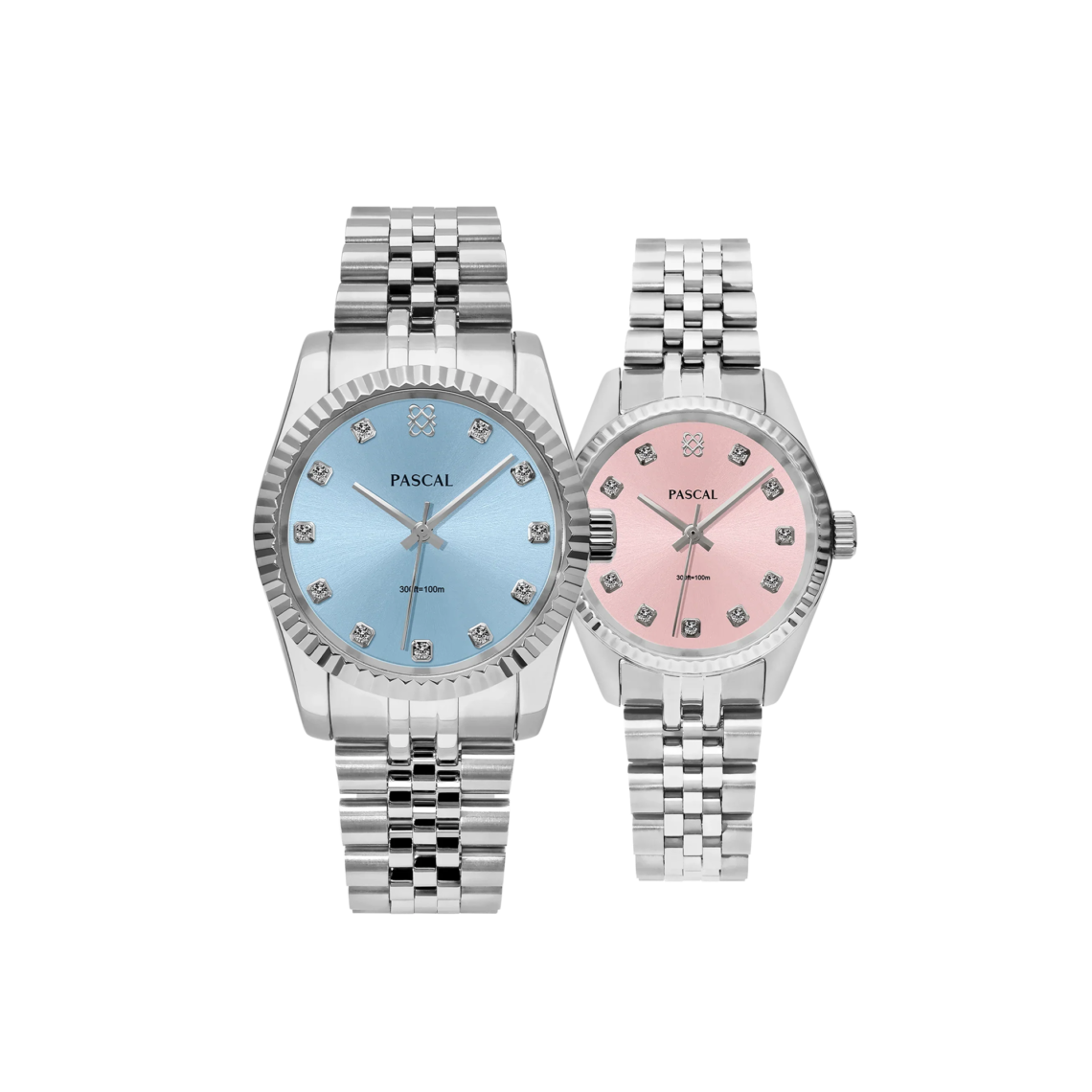
There’s a version of couples accessories that makes people uncomfortable: identical pieces in different sizes, with the shared-object narrative announced loudly before anyone asks. It’s the accessory equivalent of finishing each other’s sentences in public — the performance of the relationship substituting for the thing itself. That version fell out of fashion alongside matching couple outfits, and for the same reason: it prioritizes signal over substance.
Modern couples watch design works on a different premise. The goal is visual coherence — two pieces that clearly belong to the same aesthetic family — not visual identity. You should be able to wear either watch separately and have it function as an individual choice. The pairing reveals itself when both pieces are together, not as the only reading available.
How PASCAL Approaches the Design Problem
The PASCAL couples wrist watch collection is built around collection consistency rather than direct mirroring. Both partners draw from the same design language — shared dial color palettes, shared metal tones, shared case geometry sensibility — but in proportions appropriate to each wrist. A 31mm women’s piece and a 40mm men’s piece from the same collection share DNA without sharing dimensions blindly.
The practical result: each watch holds up independently. On its own, the women’s piece reads as an elegant everyday watch. On its own, the men’s piece reads as a clean dress watch. Together, they read as a considered pair. That’s a different design outcome from making one watch twice in different sizes.
Why Proportion Matters More Than People Realize
The most common failure in his-and-hers watches is scaling without redesigning. A 42mm case isn’t 28mm — it’s a different case. The proportional relationships between dial, indices, hands, and bezel that work at 42mm often look cramped, wrong, or disproportionate at 28mm. Manufacturers who just scale the template down produce pieces that look like shrunken versions of the men’s watch rather than women’s watches in their own right.
PASCAL designs each size to its intended wrist scale, which means the dial layout, index size, and hand proportions are reconsidered for each piece rather than mathematically reduced. This matters most in person — in photographs, the difference is visible; on the wrist, it’s unmistakable.
When to Give Couples Watches and When Not To
Couples watches work best as milestone gifts — pieces tied to a specific moment rather than given as general anniversary-of-your-relationship tokens. First anniversary. Engagement. A decision made together. A relocation. The watch marks the moment; the moment gives the watch meaning beyond its function.
Where they work less well: as general holiday gifts between couples who don’t have a strong existing interest in watches. The pairing logic requires some buy-in from both recipients. A watch gift is most successful when the recipient actually wears watches — otherwise, the couples element is doing all the work and the gift is symbolic rather than practical.
What to Look For Beyond Aesthetics
Movement parity matters. Both watches in a couple’s pair should use comparable movements — both quartz, both at similar tolerance levels — so they age at similar rates. A watch that requires service every two years alongside one that runs maintenance-free for a decade creates practical imbalance.
PASCAL standardizes Swiss quartz movements (±15 seconds/month) across their couples collection. Both watches carry the same 24-month warranty, the same 3 ATM water resistance standard, the same stainless steel construction. The practical care profile of both pieces is identical, which removes one source of future friction.
PASCAL also offers caseback engraving on their personalized models — a date, initials, a short phrase that ties the watch to the moment it was given. Over time, this turns a beautiful object into a durable record of a specific occasion.