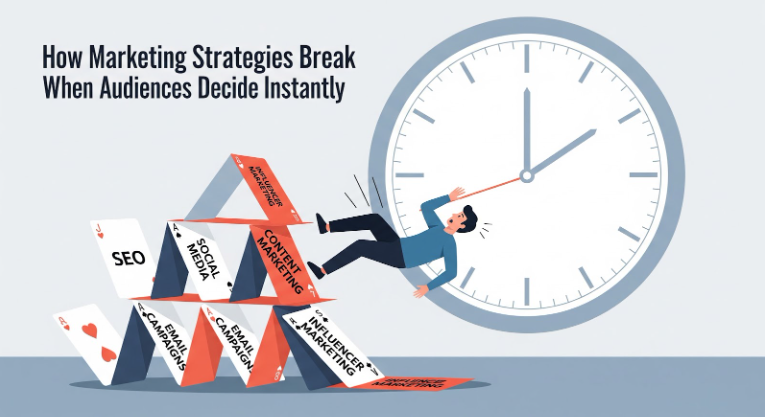
Marketing used to assume time.
Time to notice an ad. Time to read a landing page. Time to move through a funnel. Time to “warm up” before buying.
That world is gone.
Now the audience decides almost immediately. Not after a pitch. Not after a nurture sequence. Not after the third touchpoint. The decision happens at first glance, the first scroll, the first two lines, the first screen.
When that’s the reality, a lot of marketing strategies fail for a simple reason: they were built for attention that no longer exists.
The New Gatekeeper Is the First Impression
Most marketing plans still rely on the same hidden assumption: if the message is good, people will give it time.
Instant decisions destroy that assumption.
The audience does not ask, “Is this well-crafted?”
They ask, “Is this for me?” and do so quickly.
That judgment is formed from signals that have nothing to do with the cleverness of the campaign:
- the first visual frame
- the first headline
- how trustworthy the brand looks at a glance
- whether the page feels safe, real, and current
- how quickly the offer becomes clear
This is why brands can “do everything right” on paper and still get ignored in the wild.
Why Traditional Funnels Break in Real Life
Funnel thinking sounds clean: awareness, consideration, conversion.
But instant-decision behavior doesn’t move in a straight line. People jump, bail, return, screenshot, ask a friend, check Reddit, scan reviews, then decide. Or they decide to ignore the brand entirely before the funnel even begins.
The main failure point is not the middle of the funnel. It’s the entry.
Most funnels leak at the exact moment they are supposed to capture attention because the first step is too slow, too vague, or too demanding.
Typical funnel killers show up immediately:
- pages that don’t explain value above the fold
- ads that feel generic or overly produced
- “learn more” CTAs that ask for time without earning it
- long intros that delay the point
- trust signals hidden below the scroll
A modern funnel only works when the first touchpoint behaves like a decision point, not a teaser.
Content Overload Makes “More” a Losing Strategy
Many marketing teams respond to declining engagement by publishing more.
More posts. More emails. More landing pages. More ads. More variations. More everything.
That approach backfires because the audience is already overloaded. People aren’t looking for more information. They’re looking for faster certainty.
Content doesn’t lose because it’s “not optimized.” It loses because it asks too much effort to interpret.
What gets skipped isn’t always long content. It’s unclear content.
Long pages can work when they do two things early:
- establish credibility quickly
- make the outcome obvious
If the first screen feels like homework, the scroll never happens.
Social Scroll Behavior Punishes Slow Starts
Most brands still build social content like a mini commercial: a slow build, a reveal, a payoff.
That structure is backwards for feeds.
Scroll environments reward immediate clarity. The first second is not an introduction. It’s a test.
The content needs to answer three questions instantly:
- What is this?
- Why should it matter?
- Why should it be trusted?
Formats that consistently perform aren’t magical. They simply respect the speed of the feed:
- direct headline overlays that state the point immediately
- visuals that look human, not stock
- “proof” elements early (screenshots, receipts, real examples)
- hooks that create immediate relevance (not vague curiosity)
This is also where reputation hits harder than marketers like to admit. A brand with weak trust signals gets punished faster in feeds because skepticism sets in immediately.
That’s one reason NetReputation pushes brands to treat credibility as a front-end marketing asset, not a cleanup project. If trust is missing, everything costs more: clicks, conversions, patience.
Email Fails When It Reads Like It Was Sent to Everyone
Inbox behavior is another form of instant decision-making. People don’t “open emails.” They approve or delete them at a glance.
Most email programs still rely on volume and cadence. But the real determinant is whether the email is immediately relevant.
Common failure patterns:
- subject lines that sound like marketing
- preview text that repeats the subject instead of adding meaning
- intros that delay the point
- long blocks of copy without visual hierarchy
- generic offers that don’t match the reader’s stage
A strong email doesn’t need to be short. It needs to be fast to understand.
When the value is clear in the first screen, longer emails can perform. When the value is unclear, even short emails get deleted.
SEO and Ads Break for the Same Reason
SEO and paid media are usually treated as separate disciplines, but instant decision-making behavior brings them together at a common point: relevance at first contact.
- SEO fails when pages rank for a term but don’t match what the searcher meant.
- Ads fail when targeting is correct, but the landing experience feels generic or untrustworthy.
Clicks are not the win anymore. Clicks are the audition.
A page can “convert badly” without being bad. It can come across poorly because it doesn’t address the audience’s immediate doubt.
That doubt is often simple:
- “Is this legit?”
- “Is this for someone like me?”
- “Will this waste my time?”
- “Why should this be believed?”
Marketing strategies that ignore those questions end up optimizing the wrong things.
What Actually Works When Decisions Are Instant
Instant-decision audiences don’t need louder marketing. They need faster certainty.
Marketing strategies hold up when they are designed around clarity, proof, and trust from the very beginning.
1) Lead with the outcome, not the backstory
The first screen should state what changes for the customer.
Not features. Not positioning. Not mission language.
Outcome.
Good: “Remove inaccurate results and rebuild your search presence.”
Weak: “We provide comprehensive solutions to enhance your digital footprint.”
The second version sounds fine, but it doesn’t help the audience decide.
2) Put proof where the decision happens
Trust elements can’t live in the footer anymore.
Place credibility signals early:
- short testimonial snippets
- logos or recognizable references (when legitimate)
- review ratings (when real and current)
- screenshots of results (when compliant and honest)
- specific guarantees are avoided unless truly supportable
This is where NetReputation’s approach is useful as a reference point: reputation work is built around what people see first, because first impressions are where outcomes are decided. That same logic applies to the marketing strategy as a whole.
3) Reduce interpretation work
If the audience has to “figure it out,” they bounce.
Make choices easy:
- fewer competing CTAs
- clearer navigation
- one primary message per page
- visual hierarchy that guides the eye
4) Design for the first five seconds
This is not just design. It’s decision engineering.
The opening experience should deliver:
- a clear promise
- a reason to believe it
- an obvious next step
Not later. Immediately.
5) Match micro-intent instead of forcing a journey
People don’t always want the full funnel. They want the next answer.
Marketing strategies perform better when the brand meets the moment:
- quick explainer content for “what is this?”
- comparison content for “is this worth it?”
- reassurance content for “is this safe/legit?”
- action pages for “let’s do it now”
This turns the funnel into a set of decision-ready entry points instead of a rigid path.
The Real Shift: Marketing Is Now a Trust Test
Instant decision-making doesn’t just change creativity. It changes what marketing is.
Marketing strategies used to be built around persuasion over time. Now they are built around credibility at first contact.
Brands that win aren’t necessarily more clever. They are easier to trust quickly.
That is the new standard. Everything else is fighting the audience’s behavior instead of respecting it. https://smartstudent8.com/