Music production has traditionally been one of the most skill-intensive, time-consuming, and expensive creative disciplines — a barrier that kept original music out of reach for most content creators, indie developers, and entrepreneurs.
An ai music agent fundamentally redefines this reality: instead of operating a complex DAW or hiring a professional composer, you simply describe what you want in plain language, and an intelligent AI system plans, composes, and masters your track from start to finish. In 2026, the gap between having a musical idea and hearing it fully produced has been reduced to minutes.
Why Traditional Music Production Fails Modern Creators
The conventional path to producing original music is riddled with barriers that modern creators simply cannot afford — in time, money, or learning investment:
- Steep software learning curves: Industry-standard tools like Ableton Live, Logic Pro, or FL Studio require months of training before you can produce anything usable
- High studio and session costs: Professional recording and mixing sessions can cost hundreds to thousands of dollars per finished track — far beyond the budgets of solo creators or small teams
- Slow creative iteration: Briefing a composer, waiting for drafts, requesting revisions, and finalizing a track can stretch a single project across days or weeks
- Royalty and licensing complexity: Using third-party music in commercial content — YouTube videos, ads, films, games — exposes you to copyright claims, takedown notices, and recurring licensing fees
- One track at a time: Traditional production is inherently sequential; building an album or a full soundtrack package requires compounding effort for every additional track
- Creative bottlenecks: Writer’s block, limited instrumentation access, and dependence on collaborators make it hard to explore ideas freely and rapidly
- No intelligent planning layer: Traditional tools generate sound but don’t think — they can’t analyze your creative brief, apply music theory, or make strategic production decisions on your behalf
These constraints collectively explain why so many creators settle for generic stock music — not because it’s better, but because the alternative has historically been too costly and complex to pursue.
What an AI Music Agent Can Do
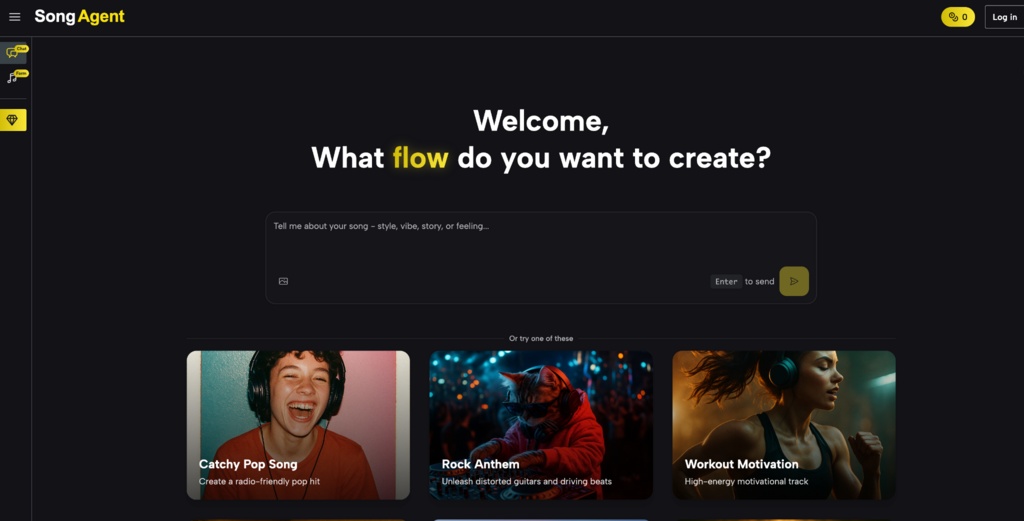
SongAgent takes a fundamentally different architectural approach to music creation. Rather than functioning as a passive generator that outputs random compositions, it operates as a true music agent — an intelligent system that listens, plans, executes, and refines your creative vision through natural conversation.
Conversational Musical Intelligence
At the heart of SongAgent is its Advanced Musical Analysis and Planning layer. Before a single note is generated, the AI deconstructs your request into musical components — melody, harmony, rhythm, structure, and emotional intent — and presents you with a complete musical blueprint for your approval. You can describe a track as “an uplifting acoustic folk song with warm vocals and fingerpicking guitar for a travel documentary” and receive not just audio, but a fully reasoned compositional plan you can review, adjust, and approve. No other music generator shows you the plan before it composes — this is what separates an agent from a generator.
Batch Composition: Entire Albums, Not Just Single Tracks
SongAgent’s batch creation engine is its most powerful production differentiator. Traditional tools process one track at a time; SongAgent can generate entire albums, EPs, full game soundtracks, or podcast music packages in a single session — with stylistic consistency maintained across every track. Describe an album concept, a 10-track indie rock project with thematic cohesion, or a complete RPG soundtrack with distinct zones and moods, and the AI handles the full production pipeline in parallel. What once took weeks of studio time now takes hours.
End-to-End Production Workflow
SongAgent covers the complete music production journey within one platform:
- AI Lyrics Generator — transform themes and keywords into professionally structured lyrics
- Text/Lyrics to Song — convert written words directly into fully composed arrangements
- Vocal Remover and Stem Extraction — isolate vocals or instruments from any track for remixing
- Extend Song — intelligently expand existing compositions without breaking their character
- MP3 to WAV Converter — upgrade exports to lossless quality for professional delivery
- Multi-genre flexibility — pop, rock, electronic, classical, jazz, hip-hop, ambient, cinematic, and custom hybrid styles
Every track generated carries 100% royalty-free commercial rights with no attribution requirements — you own your output completely.
How to Get the Most from Your AI Music Agent
Whether you’re scoring a film, launching a podcast, or building a personal music catalog, SongAgent adapts to your workflow. Here are the most impactful use scenarios:
Step 1: Start with a Conversational Brief
Open SongAgent and describe your music in plain language — genre, mood, tempo, instrumentation, vocal style, and intended use. The more context you provide, the more precisely the AI can plan and execute. Example: “cinematic orchestral track, slow build, no vocals, for a documentary opening scene.”
Step 2: Review the Musical Blueprint
Before generation begins, review the AI’s compositional plan — structure, key, tempo, arrangement strategy — and request any adjustments through conversation. This planning layer is unique to SongAgent and ensures your creative intent is accurately reflected before any audio is produced.
Step 3: Generate and Iterate
Click “Create” and receive your finished track in seconds. If you want variations, continue the conversation to refine specific elements — “make the bridge more dramatic” or “add a piano melody in the second verse” — and the agent adapts without starting from scratch.
Step 4: Use Batch Mode for Large Projects
For albums, game soundtracks, or branded audio packages, activate Batch Composition mode and define your full project scope in a single session. SongAgent generates all tracks with stylistic consistency, saving hours of sequential production work.
Step 5: Export and Deploy
Download your tracks in MP3 or WAV format, fully watermark-free with commercial rights attached. Use them immediately in any project — YouTube, Spotify, TikTok, film, game, or podcast — with zero licensing concerns.
AI Music Agent Tools at a Glance
| Tool | Core Strength | Best For | Free Plan |
| SongAgent | Conversational AI agent, musical blueprint preview, batch album creation, full production suite | Creators, game devs, podcasters, brands, educators | Yes — free to start, no credit card |
| Suno AI | Fast single-track generation, large community | Casual social media creators | Yes |
| Udio | High audio fidelity, diverse genre output | Music enthusiasts and producers | Yes |
| Soundraw | Loop-based background music generation | Video editors needing ambient tracks | Limited |
| ToMusic.ai | Multi-model engine, 8-minute compositions | Creators needing long-form audio | Yes |
The defining difference with SongAgent is its agent-first architecture: it doesn’t just generate music — it thinks through your brief, plans the composition, and executes a complete production workflow through conversation. For anyone who needs to produce music at scale — albums, soundtracks, branded audio packages — no other platform matches its combination of intelligence, batch capability, and end-to-end production tools.
Start Creating Music the Way You Think
The question for modern creators in 2026 is no longer “should I use AI for music?” — it’s “which AI music agent gives me the most creative control?” Conversational planning, batch album production, royalty-free commercial rights, and a complete production suite in one platform represent a genuine step-change from anything traditional workflows or simpler generators can offer.
If you’re ready to stop wrestling with complex DAWs and start creating music the way you think — through conversation — try SongAgent free today and hear what your ideas actually sound like. No studio required, no music theory needed, and no limits on what you can create.