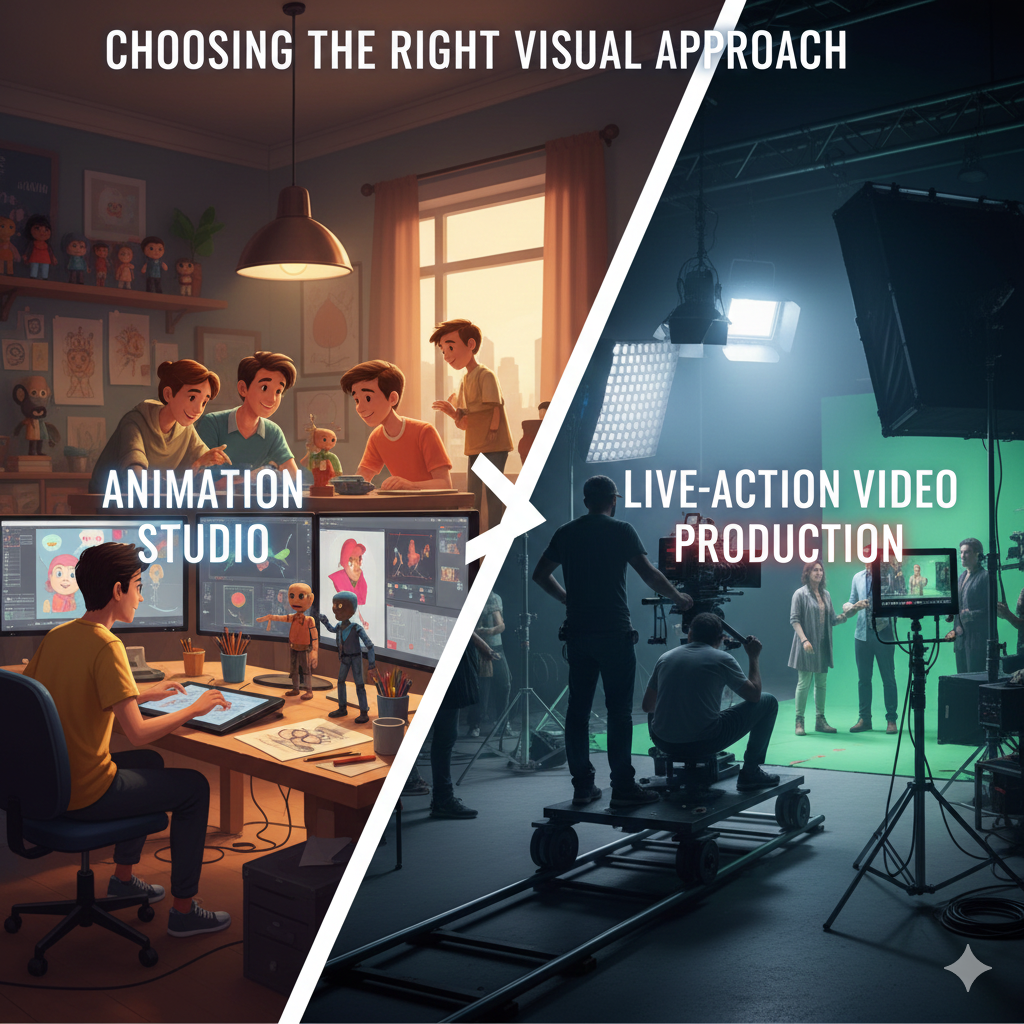
When you decide to invest in video, one of the first big questions isn’t about budget or length—it’s about format. Should this story be told with real people in real locations, or through animation? Both can be powerful. Both can convert. But they work in very different ways, and choosing the wrong approach can make even a strong concept feel flat.
If you’re weighing up live action against working with an animation studio melbourne based team, it helps to zoom out and look at what you’re actually trying to achieve.
What Live-Action Video Does Best
Live-action video feels immediate and familiar. You see real faces, hear real voices and get a genuine sense of place. That makes it ideal when trust, personality and physical experience sit at the heart of your offer.
Live action is usually the stronger choice when you want to:
Show real people
Think founders, key staff, customers or experts. Viewers connect quickly when they can read facial expressions, body language and tone. Brand films, testimonials and recruitment videos often rely on that human presence.
Demonstrate a physical product or space
If your offer is hands-on—a clinic, restaurant, venue, factory, retail store or physical product—seeing it “in the wild” matters. Live action captures how it really looks and works in everyday use.
Capture culture and events
Conferences, launches, activations and behind-the-scenes content are built for live action. They’re about atmosphere, reactions and moments that only exist briefly in time.
The trade-off is that live action is tied to reality. You’re dealing with schedules, weather, locations, availability and the natural nerves many people feel in front of a camera. If your offer changes frequently, reshoots can also add up.
Where Animation Really Shines
Animation removes those physical limits. You can visualise abstract ideas, travel inside a product or show processes that don’t exist in one neat place. You’re no longer restricted by what a camera can see.
Animation often outperforms live action when:
Your product or service is complex or invisible
Software platforms, financial tools, AI products, logistics systems and data-driven services can be hard to “show” in real life. Animation can simplify all of that into clean, intuitive visual stories.
You need to educate quickly
Explainer videos, onboarding content and training modules benefit from animation because you can control every frame. You decide exactly where the viewer’s eye should go and how fast the information flows.
You want a highly controlled, consistent style
Animated assets can be designed to match your brand colours, typography and illustration style precisely. That look can then be reused and adapted across campaigns, markets and languages with minimal disruption.
The main challenge with animation is that it demands clear thinking upfront. Once the storyboard, visual style and timing are locked in, major changes late in the project can be time-consuming. Planning and sign-off at each stage become critical.
Key Factors to Help You Decide
If you’re on the fence, a few practical questions usually make the decision clearer.
What are people actually buying?
If the real differentiator is your culture, your team or a physical experience, live action has a natural advantage. If they’re buying clarity, simplicity and understanding around a complex idea, animation is often more effective.
How stable is the messaging?
A long-lived brand film or origin story can justify a location-heavy live-action shoot. If your product features, pricing or positioning shift regularly, it may be smarter to build an animated foundation that’s easier to update in smaller pieces.
Where will the video be used?
Conference openers, brand films and recruitment pieces often lean live action. Website explainers, in-app tutorials, sales enablement clips and social “how it works” content often lean animated. Mapping your main channels and audiences helps you see which format will work hardest.
What timeline and access do you have?
If you can’t easily get everyone in one place, or your locations are difficult to film in, animation (or a hybrid approach) may offer more control. If you already have strong spokespeople and great spaces ready to go, live action can be very efficient.
The Power of Hybrid: Mixing Animation and Live Action
You don’t always have to choose one format and stick to it forever. Some of the most effective brand videos use both approaches in a single piece.
For example, you might film a customer interview, then overlay animated UI elements to show how your product works in context. Or you might capture your team on site, then use motion graphics and icons to highlight data, timelines or outcomes.
This blend keeps the human connection of live action while using animation to clarify details and make key messages more memorable. It’s especially effective for B2B brands and organisations with technical offers that still depend on relationships.
Budget, Longevity and ROI
Both animation and live action can be scaled up or down depending on your budget, but they scale differently.
Live action costs are driven by locations, talent, crew size, gear, travel and shoot days. A carefully planned one-day shoot can still deliver a lot of content if you’re strategic with your schedule and shot list.
Animation costs depend more on style complexity, length and the amount of custom illustration and motion involved. A simple, clean explainer may be very cost-effective, while detailed character animation will naturally require more time and budget.
In both cases, it’s useful to think not just in terms of one video, but a content set. Can the footage or assets be broken into shorter clips, reused across platforms or repurposed in future campaigns? A slightly larger investment that produces a flexible library often delivers better ROI than a stand-alone piece.
Choosing the Right Creative Partner
Once you’ve leaned toward animation, live action or a hybrid, the next step is choosing who will bring that vision to life.
Look for a team that starts by asking about your goals, audience and distribution, not just your budget. Check that their portfolio shows both strong storytelling and strong craft in your chosen format, and make sure they can explain their process clearly so you know what happens at concept, scripting, production and revisions.
If you want the flexibility to move between formats as your needs evolve, working with a studio that handles both disciplines helps. A company like Diprose Media, for example, offers both specialist animation services and full-service Video production Melbourne capabilities, so you’re not locked into one approach.
Ultimately, the choice between animation and live action isn’t about which is “better” in general. It’s about which is better for this story, this audience and this moment in your brand’s growth. When you choose with that in mind, your video becomes much more than content—it becomes a clear, memorable expression of what you do and why it matters.