Introduction
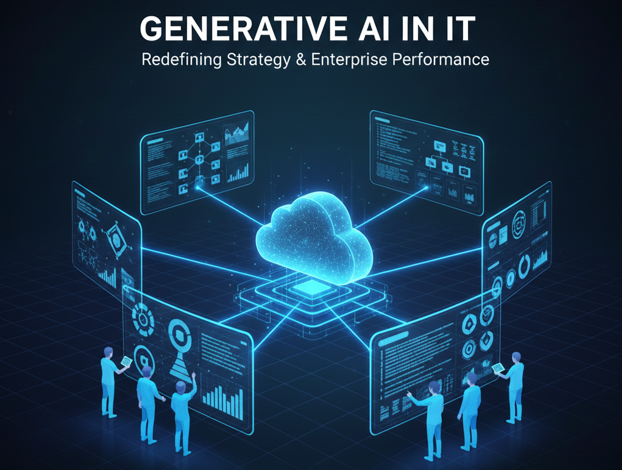
Generative AI has moved beyond experimentation and into the core of enterprise IT strategy. What began as a set of productivity tools has evolved into a powerful capability that reshapes how IT organisations design services, manage complexity, and deliver value at scale. As enterprises face rising technology costs, growing cybersecurity risks, and persistent talent shortages, IT leaders are under pressure to modernise faster while maintaining operational stability.
Unlike traditional automation or analytics, generative AI enables IT teams to synthesise information, generate code and content, and augment decision-making in real time. This shift is transforming IT from a support function into a strategic enabler of business agility and innovation. For organisations seeking sustainable digital advantage, understanding how generative AI fits into the IT operating model is now essential.
Overview of generative AI in IT
Generative AI refers to models that can produce new outputs, such as text, code, images, and structured insights, based on learned patterns from large datasets. Within IT, these capabilities extend far beyond chat interfaces. They are increasingly embedded into service management platforms, development environments, security tools, and infrastructure operations.
As adoption grows, many enterprises are exploring Gen AI in IT to modernise core functions such as application development, incident management, and enterprise architecture. Unlike earlier waves of AI, generative models excel at contextual reasoning, enabling IT systems to interpret intent, recommend actions, and automate complex workflows with minimal human intervention.
From an operating model perspective, generative AI supports a shift toward more product-centric IT organisations. Teams can reduce manual effort, accelerate release cycles, and improve service quality while aligning more closely with business outcomes. The technology also complements cloud-native architectures and DevOps practices, making it a natural extension of ongoing digital transformation initiatives.
Benefits of generative AI in IT
Improved productivity and operational efficiency
One of the most immediate benefits of generative AI in IT is productivity improvement. By automating routine tasks such as ticket triage, documentation, and code generation, IT teams can redirect effort toward higher-value work. This is especially critical as many organisations struggle to scale IT capacity without proportional increases in headcount.
Generative AI can summarise logs, propose resolutions, and generate scripts, reducing cycle times across development and operations. Over time, these gains translate into lower run costs and more predictable service delivery.
Faster software development and modernisation
Application development is another area where generative AI delivers measurable impact. Models trained on enterprise codebases can assist developers with writing, refactoring, and testing code. This accelerates modernisation initiatives, particularly for legacy systems that are costly to maintain and difficult to evolve.
By reducing technical debt and improving development velocity, IT organisations can respond faster to business needs while maintaining quality and governance standards.
Enhanced service quality and user experience
Generative AI improves the IT service experience for both internal users and customers. Intelligent virtual agents can resolve common issues, guide users through self-service workflows, and escalate complex incidents with full context. This leads to faster resolution times and higher satisfaction scores.
For IT leaders, improved service quality also means better alignment with business stakeholders and stronger credibility as a strategic partner.
Stronger decision-making and insights
Generative AI supports data-driven decision-making by synthesising information across multiple systems. IT leaders can use these insights to forecast demand, optimise resource allocation, and identify risks before they escalate. When paired with benchmarking and performance metrics, this capability enables more proactive and informed technology management.
Many organisations turn to generative AI consulting services to ensure these benefits are realised in a controlled and scalable way, particularly when integrating generative AI into mission-critical IT processes.
Use cases of generative AI in IT
IT service management and support
In IT service management, generative AI enhances incident detection, root cause analysis, and resolution recommendations. Virtual agents can interpret user requests, classify tickets accurately, and suggest the best actions to support teams. This reduces mean time to resolution and improves overall service reliability.
Over time, these systems learn from historical data, enabling continuous improvement in service outcomes.
Application development and DevOps
Generative AI plays a growing role across the software development lifecycle. Developers use AI-assisted coding tools to accelerate builds, generate test cases, and identify defects earlier. In DevOps environments, generative models help optimise pipelines and automate configuration management.
These capabilities support faster releases while maintaining security and compliance requirements.
Cybersecurity and risk management
Security teams use generative AI to analyse large volumes of threat data and generate actionable insights. The technology can identify anomalies, simulate attack scenarios, and recommend mitigation strategies. This is particularly valuable as attack surfaces expand and threats become more sophisticated.
By augmenting human expertise, generative AI strengthens enterprise resilience without overwhelming security teams.
Infrastructure and cloud operations
In infrastructure management, generative AI assists with capacity planning, performance optimisation, and cost management. Models can analyse usage patterns, recommend configuration changes, and predict failures before they occur. This proactive approach improves uptime and supports more efficient cloud and hybrid environments.
Enterprise architecture and transformation planning
Generative AI also supports strategic IT planning. By synthesising data across applications, platforms, and business processes, IT leaders can assess modernisation opportunities and prioritise investments. This capability is handy for large enterprises managing complex technology landscapes.
Why choose The Hackett Group® for implementing generative AI in IT
Successfully implementing generative AI in IT requires more than technology selection. It demands a clear strategy, strong governance, and alignment with business objectives. The Hackett Group® brings a research-driven approach that combines benchmarking insights with practical transformation frameworks to help organisations adopt generative AI responsibly and effectively.
Its methodology emphasises value realisation, risk management, and alignment with the operating model. By grounding AI initiatives in proven performance benchmarks, organisations can avoid fragmented deployments and focus on scalable impact.
The Hackett AI XPLR™ platform supports this approach by enabling structured exploration and prioritisation of AI use cases across IT functions. This ensures generative AI investments are tied to measurable outcomes rather than isolated experiments.
Conclusion
Generative AI is rapidly becoming a foundational capability for modern IT organisations. From improving productivity and service quality to accelerating modernisation and strengthening security, its impact spans the entire IT value chain. However, realising these benefits requires a disciplined approach that balances innovation with governance and strategic alignment.
As enterprises navigate this transformation, IT leaders who adopt generative AI thoughtfully will be better positioned to deliver sustained business value. By embedding generative AI into core IT processes and operating models, organisations can move beyond efficiency gains and unlock new levels of agility, resilience, and competitive advantage.