If you work in an ABA practice, you have probably heard people mix up 97157 and 97158. They look similar on the claim, they use the same 15 minute unit structure, and both involve caregivers. But they are not interchangeable. Using the wrong one can trigger denials, payment takebacks, or uncomfortable audit questions.
One reason the confusion sticks around is that people remember the setting and forget the purpose. They think group equals 97158 and one on one equals 97157, then stop there. That shortcut is only partly true. What matters more is what service was delivered, who received it, and how the note shows it.
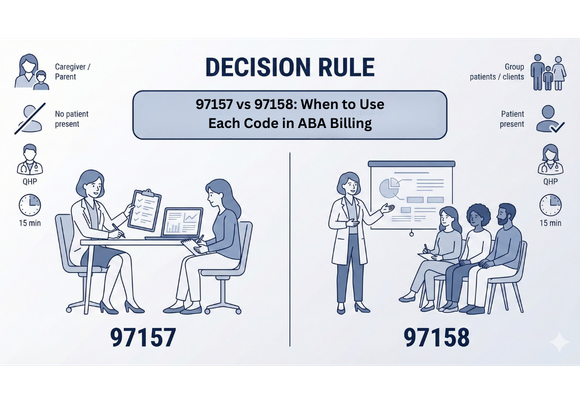
The simplest decision rule: who’s in the room and what service is delivered
Ask two questions:
- Is the service focused on training or guiding caregivers, not treating the client directly?
- If yes, was the guidance delivered to one caregiver unit or to multiple caregivers together?
If it is caregiver guidance delivered one to one, you are usually in 97157 territory. If it is structured caregiver guidance delivered in a group format, you are usually in 97158 territory. In both cases, the intent is caregiver training tied to the client’s treatment plan, not direct therapy with the client.
Many practices also use ABA therapy billing services as a second set of eyes for documentation consistency, especially when a payer’s rules or authorizations are strict. That is not about outsourcing the whole process. It is about reducing avoidable mistakes before money is on the line.
Understanding CPT 97157
97157 is used when a qualified provider works face to face with a caregiver to teach them how to support the client’s goals outside of the session. Think coaching, teaching, and problem solving with the caregiver.
Common real-life uses of 97157
- Teaching a parent how to run a reinforcement plan at home
- Practicing how to respond to a specific challenging behavior using the treatment plan
- Reviewing data with the caregiver and turning it into home routines
- Training a caregiver on prompting steps, fading, or prevention strategies
- Updating caregiver steps after a treatment plan change
What the note should show
A strong 97157 note usually includes:
- Who attended and their role, such as parent, guardian, or caregiver
- The skill or strategy taught
- How the training ties to the client’s treatment goals
- What the caregiver practiced or demonstrated
- Any barriers and how they were addressed
- A clear plan for carryover outside the session
A common error is writing the note like a direct therapy session with the client. If the documentation reads like the provider treated the client, many payers will question why a caregiver guidance code was used.
Understanding CPT 97158
97158 is used when caregiver guidance happens in a group setting. It is still guidance and training, but delivered to multiple caregivers or support people at the same time. The group structure is the defining feature, not the topic alone.
Common real-life uses of 97158
- A structured parent training class for several families working on similar skill areas
- Group teaching on reinforcement systems, antecedent supports, or daily routines
- A workshop on safe response steps, prevention plans, or de escalation methods
- Coaching multiple caregivers on how to generalize skills across settings
- A planned group session focused on consistency and carryover
What the note should show
A clean 97158 note usually includes:
- The topic and teaching plan for the group
- Names or identifiers for who attended
- The group format and basic structure
- The teaching content and practice element
- How the training supports each client’s treatment goals
- Any individualized guidance provided, if applicable
A frequent weak spot is vague documentation, such as “parent group held” with no content, no link to goals, and no clear teaching element.
Quick comparison table
| Question | 97157 | 97158 |
| Who receives the service? | Multiple sets of caregivers/guardians | Multiple patients |
| What is delivered? | Guidance and training | Group adaptive behavior treatment |
| Group format required? | Yes | Yes |
| Client present? | No (patient not present) | Client presence is required |
| Documentation focus | Skills taught to caregiver | Patient participation, goals, protocol modifications, attendance |
Payers can vary on whether the client may be present for these guidance codes, and how they interpret certain scenarios. Your safest approach is to follow the authorization and the payer’s published guidance, then document clearly to match that intent.
Common Billing Mistakes to Avoid
1) Mixing up 97158 with group treatment
Group treatment with multiple clients is typically billed under other codes, not 97158. 97158 is group guidance. When teams describe 97158 as client group treatment, it creates a mismatch between clinical delivery and billing language, which is exactly what audits look for.
2) Overlapping time
If the same provider is billing a direct treatment code at the same time as a caregiver guidance code, that overlap will be questioned. Even when two services occur on the same day, the time blocks should not collide.
3) Missing medical necessity link
Both codes need a clear connection to the treatment plan. If the note does not show why caregiver training was needed and how it supports client outcomes, a payer may deny even if the code selection is technically correct.
4) Authorization assumptions
Some payers require explicit authorization for caregiver training and group guidance. Others bundle them under broader plans. Either way, verify the approved codes and unit limits before scheduling.
This is also where internal checklists help. A billing lead or ABA billing services partner can build a simple pre-claim review that catches the most common issues: wrong code, wrong attendee, missing goal link, missing group details, or an authorization mismatch.
A short checklist you can use every time
Before billing 97157 or 97158, confirm:
- The session purpose was caregiver training or guidance, not direct treatment
- The documentation states who attended and what was taught
- The content ties back to treatment goals and expected carryover
- The time units match the session length and do not overlap other billed services
- Authorization and payer rules support the code and unit count
- For 97158, the group structure, attendance, and teaching plan are clearly written
If you can answer those items confidently, you are in a much safer position.
FAQs
1) What is the main difference between 97157 and 97158?
97157 is caregiver guidance delivered to one caregiver unit. 97158 is caregiver guidance delivered in a group setting to multiple caregivers at once.
2) Do these codes require the client to be absent?
Often the client is not present, but rules vary by payer and authorization. The safest approach is to follow the payer guidance and document the situation clearly.
3) What is the biggest documentation mistake with 97157?
Writing the note is like direct therapy with the client instead of caregiver training. The note should read like coaching, teaching, practice, and carryover planning for the caregiver.
4) What is the biggest documentation mistake with 97158?
Failing to show the group structure. A solid note should include the training topic, who attended, what was taught, and how it supports treatment goals.
5) Can 97157 and 97158 be billed on the same day?
Sometimes they can, if they are separate services, time does not overlap, and authorization supports both. Documentation should make the separation obvious.
Conclusion
Choosing between 97157 and 97158 is simpler than it looks when you focus on the intent. Both are caregiver guidance codes. The difference is whether the training was delivered one to one or in a structured group.
When you match the code to the real service, document the training clearly, and stay aligned with authorization limits, you protect both revenue and compliance. That is what keeps billing predictable and reduces unpleasant surprises later.